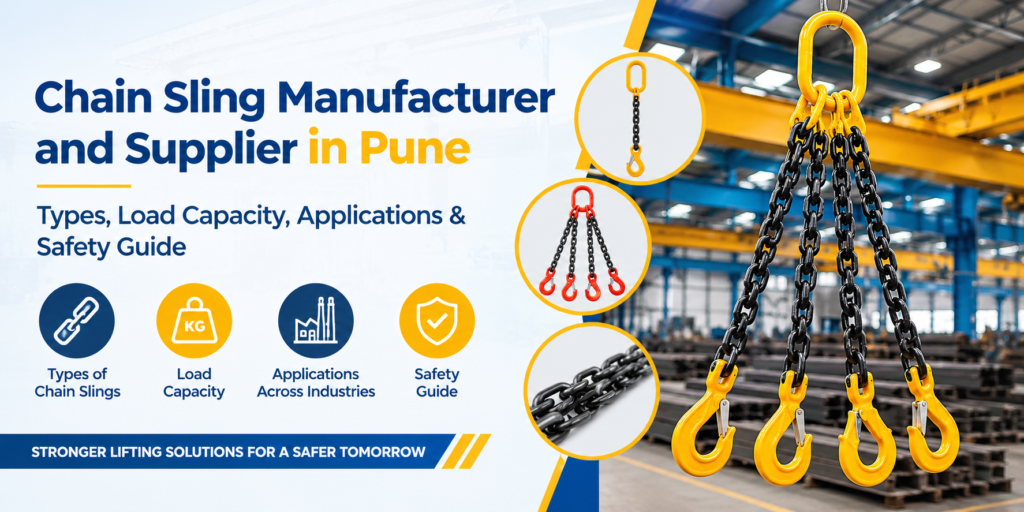
When it comes to heavy lifting, material handling, and industrial rigging, choosing the right lifting equipment is essential for workplace safety and operational efficiency. Chain slings are widely used across manufacturing plants, construction sites, engineering industries, warehouses, and infrastructure projects because of their strength, durability, and flexibility.
As a trusted Chain Sling Manufacturer and Supplier in Pune, SVIBO Industries provides reliable chain sling solutions designed for demanding lifting applications. Chain slings can be configured with different legs, hooks, connecting components, and lengths according to the lifting requirements.
This guide explains the major types of chain slings, load capacity, applications, safety practices, and important factors to consider when selecting a chain sling.
What Is a Chain Sling?
A chain sling is a lifting assembly made from high-strength alloy steel chain and suitable lifting components such as master links, hooks, connecting links, and other fittings. It is used to connect a load to a crane, hoist, or other lifting equipment.
Depending on the application, chain slings can be supplied as single-leg, double-leg, triple-leg, or four-leg configurations.
The appropriate sling configuration depends on factors such as:
- Load weight
- Load shape and dimensions
- Centre of gravity
- Lifting angle
- Working Load Limit (WLL)
- Chain grade and diameter
- Type of hooks and fittings
- Lifting environment
Selecting the correct chain sling is important because the rated capacity of a sling can change depending on how it is configured and used.
Chain Sling Manufacturer and Supplier in Pune
Pune has a strong industrial ecosystem covering engineering, automotive, manufacturing, construction, infrastructure, and fabrication industries. These sectors frequently require dependable lifting and rigging equipment for handling heavy components and materials.
SVIBO Industries serves industrial requirements as a Chain Sling Manufacturer and Supplier in Pune, offering chain sling solutions for various lifting applications.
The right chain sling should not be selected only based on chain diameter or price. Factors such as grade, configuration, lifting angle, hook type, WLL, and application conditions should also be considered.
Types of Chain Slings
Different lifting operations require different chain sling configurations. Some of the commonly used types include:
1. Single-Leg Chain Sling
A single-leg chain sling consists of one chain leg with suitable end fittings. It is useful when a straightforward vertical lifting arrangement is required.
Common applications include:
- Machinery lifting
- Material handling
- Workshop lifting
- Fabrication work
- General industrial applications
The rated capacity must always be checked before lifting.
2. Double-Leg Chain Sling
A double-leg chain sling uses two chain legs connected to a master link or suitable top fitting. It provides greater flexibility when supporting loads at two lifting points.
It is commonly used for:
- Machinery
- Steel structures
- Industrial components
- Fabricated equipment
- Heavy material handling
The lifting angle has a significant effect on the capacity of multi-leg slings.
3. Three-Leg Chain Sling
Three-leg chain slings are designed for loads requiring three lifting points. They can provide better load distribution when appropriately designed and used.
They are suitable for certain:
- Industrial machinery
- Structural components
- Fabricated assemblies
- Heavy equipment
- Engineering applications
A competent person should determine whether the load and lifting arrangement are suitable for a three-leg configuration.
4. Four-Leg Chain Sling
Four-leg chain slings are used for loads with multiple lifting points. They are commonly considered for large and heavy components where a multi-point lifting arrangement is required.
Applications may include:
- Heavy machinery
- Industrial equipment
- Steel structures
- Large fabricated components
- Construction materials
The actual lifting capacity should be determined based on the manufacturer’s rated configuration and applicable lifting conditions.
5. Adjustable Chain Slings
Adjustable chain sling arrangements can be useful when different lifting lengths or attachment positions are required. They offer flexibility for selected industrial applications.
However, adjustment must be carried out according to the manufacturer’s specifications and safe lifting practices.
Understanding Chain Sling Load Capacity
One of the most important factors when selecting a chain sling is its Working Load Limit (WLL).
WLL indicates the maximum load that a lifting assembly is rated to handle under specified conditions. It should not be confused with the breaking load of the chain.
The capacity of a chain sling depends on several factors, including:
- Chain diameter
- Chain grade
- Number of legs
- Sling configuration
- Lifting angle
- Hitch type
- Hook and fitting capacity
- Load distribution
- Condition of the sling
Why Lifting Angle Matters
For multi-leg chain slings, the angle between the sling legs can affect the forces acting on each leg. As the sling angle becomes more horizontal, the tension in each leg increases.
Therefore, simply adding the capacities of individual chain legs is not an appropriate way to determine the total safe lifting capacity.
Always refer to the manufacturer’s rated capacity chart and applicable lifting standards before using a chain sling.
Common Chain Grades
Chain slings are generally manufactured using high-strength alloy steel chains designed for lifting applications.
Common lifting chain grades include:
Grade 80 Chain Slings
Grade 80 chain is widely used for lifting and material-handling applications. It provides a combination of strength, durability, and versatility.
Grade 100 Chain Slings
Grade 100 chain provides higher strength compared with Grade 80 chain for appropriately designed lifting applications. It can allow certain loads to be lifted using a smaller chain size, subject to the manufacturer’s rated capacity.
The selection between Grade 80 and Grade 100 should be based on the required WLL, application, lifting configuration, applicable standards, and manufacturer recommendations.
Applications of Chain Slings
Chain slings are used in a wide range of industries because they can handle demanding lifting environments.
Manufacturing Industries
Manufacturing plants use chain slings for lifting machinery, components, dies, fabricated structures, and other heavy materials.
Construction
Construction companies use chain slings for lifting steel structures, construction equipment, pipes, beams, and other materials.
Engineering and Fabrication
Engineering and fabrication units frequently require chain slings for moving fabricated equipment and large metal components.
Automotive Industry
Automotive manufacturing and ancillary facilities may use lifting equipment for handling dies, machinery, assemblies, and production components.
Warehousing and Material Handling
Chain slings can also be used for specific heavy-duty material-handling operations where appropriate lifting equipment is required.
Infrastructure Projects
Large infrastructure projects may require chain slings for lifting structural components and heavy equipment.
Benefits of Using Chain Slings
Choosing a properly designed and maintained chain sling can provide several advantages.
High Strength
Alloy steel lifting chains are designed to provide high strength for demanding lifting operations.
Durability
Quality chain slings can withstand demanding industrial environments when correctly selected, used, inspected, and maintained.
Flexibility
Different leg configurations and fittings allow chain slings to be adapted to different lifting arrangements.
Adjustable Length
Certain chain sling configurations can provide useful length adjustment for specific lifting applications.
Suitable for Demanding Conditions
Chain slings can be suitable for many industrial environments where robust lifting equipment is required, subject to temperature, chemical exposure, and other operating limitations.
Chain Sling Safety Guide
Safe lifting depends not only on the quality of the chain sling but also on correct selection, inspection, installation, and handling.
1. Check the WLL
Never exceed the marked Working Load Limit of the chain sling.
2. Inspect Before Use
Check the chain and fittings for:
- Cracks
- Excessive wear
- Bending
- Stretching
- Corrosion
- Damaged hooks
- Deformed links
- Missing identification tags
Any sling showing significant damage should be removed from service and evaluated by a competent person.
3. Check the Load Weight
Know the actual weight of the load before selecting the sling. Never estimate the load weight when accurate information is available.
4. Consider the Centre of Gravity
The lifting points should be positioned appropriately relative to the load’s centre of gravity to help maintain stability during lifting.
5. Avoid Shock Loading
Sudden starts, stops, jerking, or dropping loads can generate forces significantly higher than the static load.
6. Protect Against Sharp Edges
Sharp edges can damage or weaken lifting chains. Appropriate protection should be used where necessary.
7. Inspect Hooks and Fittings
Hooks, master links, connecting links, and other components should be compatible with the chain and rated appropriately for the lifting application.
8. Follow Correct Sling Angles
Do not use a multi-leg sling configuration without considering the effect of the lifting angle on the sling capacity.
9. Do Not Knot or Twist the Chain
Chains should be positioned correctly and should not be knotted or improperly twisted during lifting.
10. Store Slings Properly
After use, chain slings should be stored in a clean and suitable location where they are protected from unnecessary damage, contamination, and corrosion.
How to Choose the Right Chain Sling
Before purchasing a chain sling from a Chain Sling Supplier in Pune, consider the following:
Load Weight: Determine the maximum weight that needs to be lifted.
Number of Lifting Points: Identify whether a single-, double-, three-, or four-leg configuration is appropriate.
Required WLL: Select a sling with a suitable rated capacity for the intended configuration.
Chain Grade: Choose the appropriate chain grade based on the application and manufacturer’s recommendations.
Chain Diameter: The required diameter depends on the required capacity and applicable specifications.
Hook Type: Select hooks according to the attachment point and lifting arrangement.
Sling Length: Determine the required length based on the dimensions of the load and lifting arrangement.
Operating Environment: Consider exposure to heat, chemicals, moisture, abrasive conditions, and other environmental factors.
Why Choose SVIBO Industries for Chain Slings?
SVIBO Industries provides industrial lifting and rigging equipment for businesses requiring dependable material-handling solutions.
As a Chain Sling Manufacturer and Supplier in Pune, SVIBO Industries focuses on providing suitable chain sling configurations for different industrial requirements.
Customers can discuss their requirements based on:
- Load capacity
- Chain grade
- Chain diameter
- Number of legs
- Sling length
- Hook configuration
- Application
- Lifting environment
The right configuration can then be selected based on the required lifting conditions and applicable specifications.
Chain Sling vs Wire Rope Sling
Both chain slings and wire rope slings have important roles in lifting operations.
| Feature | Chain Sling | Wire Rope Sling |
| Construction | Alloy steel chain | Steel wire rope |
| Flexibility | High | High |
| Durability | Excellent for many demanding applications | Suitable for many industrial applications |
| Length adjustment | Possible with suitable configurations | Generally less convenient |
| Temperature resistance | Application-dependent | Application-dependent |
| Heavy-duty use | Widely used | Widely used |
| Maintenance | Regular inspection required | Regular inspection required |
The best option depends on the load, lifting configuration, operating environment, required flexibility, and equipment specifications.
Importance of Quality in Chain Slings
A chain sling is a critical component in a lifting system. Using an incorrectly rated or damaged sling can create serious safety risks.
A reliable supplier should be able to provide information about:
- Chain grade
- WLL
- Sling configuration
- Component specifications
- Applicable standards
- Identification and traceability
- Inspection requirements
Businesses should avoid selecting lifting equipment based solely on the lowest price. Quality, suitability, certification, and safe working capacity are important considerations.
Conclusion
Chain slings are an important part of industrial lifting and material-handling operations. From manufacturing and engineering to construction and infrastructure, the right chain sling can provide a practical solution for handling heavy loads.
If you are searching for a Chain Sling Manufacturer and Supplier in Pune, choosing a supplier that understands your load requirements, lifting configuration, chain grade, WLL, and application conditions can help you select the appropriate solution.
SVIBO Industries offers chain sling and lifting equipment solutions for industrial requirements, helping businesses identify suitable products for their lifting and rigging applications.
Frequently Asked Questions
1. What is a chain sling used for?
Chain slings are used to lift, move, and position heavy loads using cranes, hoists, and other compatible lifting equipment.
2. What are the common types of chain slings?
Common configurations include single-leg, double-leg, three-leg, four-leg, and adjustable chain sling arrangements.
3. How is chain sling capacity determined?
Capacity depends on factors such as chain grade, diameter, number of legs, configuration, lifting angle, hitch type, and component ratings.
4. What is WLL in chain slings?
WLL stands for Working Load Limit. It represents the maximum load a lifting assembly is rated to handle under specified conditions.
5. Can chain slings be used for all heavy loads?
No. The sling must be selected according to the load weight, lifting configuration, centre of gravity, environment, and manufacturer’s rated capacity.
6. How often should chain slings be inspected?
Chain slings should be inspected before use and periodically according to applicable regulations, standards, manufacturer recommendations, and workplace procedures.
7. Why is the lifting angle important?
The lifting angle affects the forces acting on individual sling legs. Smaller angles from the horizontal can increase tension and reduce the effective capacity of a multi-leg sling.
8. Where can I find a Chain Sling Manufacturer and Supplier in Pune?
SVIBO Industries provides chain slings and other lifting and rigging equipment for industrial applications in Pune and across India.