When it comes to lifting, rigging, material handling, and industrial applications, choosing the right fastening and lifting hardware is essential for safety and operational efficiency. Eye bolts are widely used to create secure lifting or attachment points for machinery, structures, equipment, and rigging systems.
SVIBO Industries is a trusted Eye Bolt Manufacturer in India and Eye Bolt Supplier in India, offering quality lifting and rigging components for diverse industrial requirements. This guide covers eye bolt types, sizes, materials, load capacity, applications, manufacturing, pricing factors, safety guidelines, and selection criteria.
What Is an Eye Bolt?
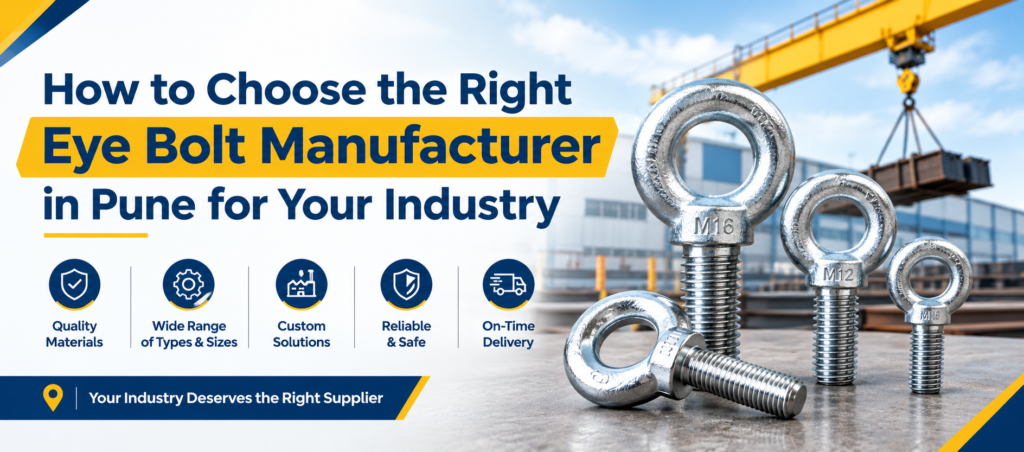
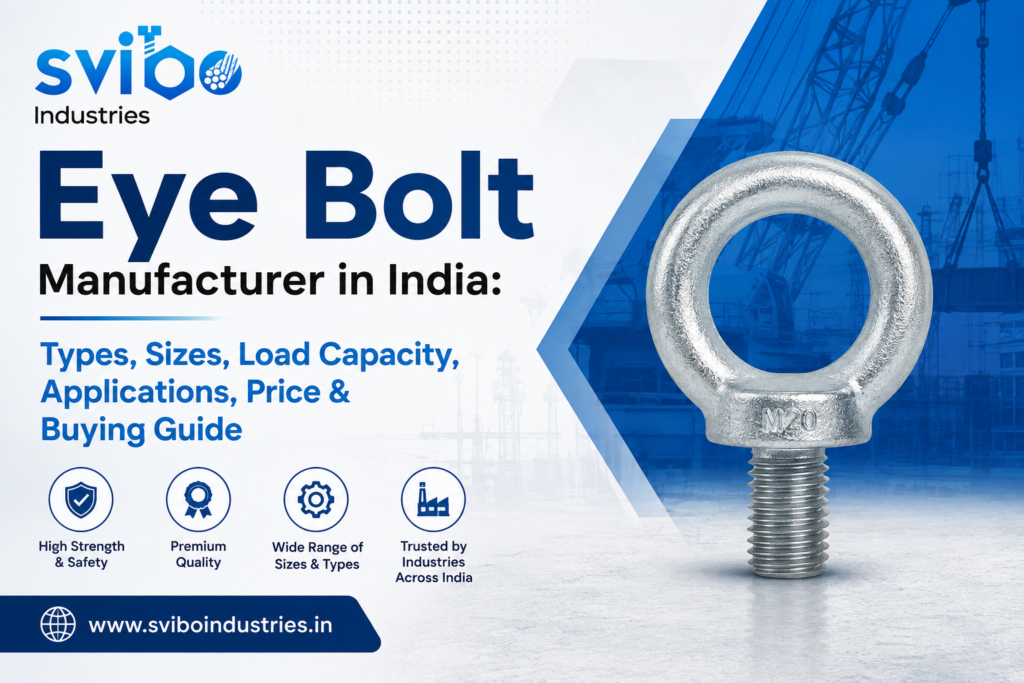
An eye bolt is a threaded fastener featuring a circular or oval-shaped eye at one end. The eye provides an attachment point for ropes, cables, hooks, slings, and other rigging components, while the threaded section allows the bolt to be secured to compatible equipment or structures.
Eye bolts are available in different designs, materials, sizes, and configurations depending on the application. Lifting eye bolts should always be selected and used according to their rated capacity and the manufacturer’s instructions.
Types of Eye Bolts
Different applications require different eye bolt designs. Some commonly used types include:
1. Forged Eye Bolts
Forged eye bolts are manufactured using a forging process that forms the metal into the required shape. They are commonly used in industrial and heavy-duty applications where strength and durability are important.
2. Heavy-Duty Eye Bolts
Heavy-duty eye bolts are designed for demanding industrial applications. They are commonly used in machinery, engineering, construction, material handling, and lifting systems.
3. Shoulder Eye Bolts
Shoulder eye bolts have a shoulder section below the eye. Depending on the manufacturer’s design and rating, shoulder eye bolts can be used for specific lifting and attachment applications.
4. Non-Shoulder Eye Bolts
Non-shoulder eye bolts are generally used where the application does not require a shoulder design. Their suitability depends on the intended loading conditions and manufacturer specifications.
5. Stainless Steel Eye Bolts
Stainless steel eye bolts provide improved corrosion resistance and are suitable for applications where exposure to moisture or corrosive environments is a concern.
6. Galvanized Eye Bolts
Galvanized eye bolts have a protective zinc coating that helps improve resistance to corrosion. They are useful for various outdoor and industrial applications.
Eye Bolt Sizes and Dimensions
Eye bolts are available in multiple thread diameters, lengths, eye dimensions, and thread configurations.
| Eye Bolt Size | Typical Application |
| M6 | Light-duty fastening and attachment |
| M8 | General industrial applications |
| M10 | Equipment and material handling |
| M12 | Industrial lifting and rigging applications |
| M16 | Heavy-duty industrial applications |
| M20 and above | Larger industrial and engineering applications |
The actual dimensions and load capacity can vary by product design. Therefore, buyers should check the manufacturer’s technical specifications before selecting an eye bolt for a lifting application.
Eye Bolt Materials and Grades
The material used to manufacture an eye bolt directly affects its strength, durability, corrosion resistance, and suitability for different environments.
Carbon Steel
Carbon steel eye bolts are commonly used for general industrial applications where strength and cost-effectiveness are important.
Alloy Steel
Alloy steel can provide enhanced mechanical properties for demanding applications when manufactured and heat-treated according to the applicable specification.
Stainless Steel
Stainless steel eye bolts are preferred in applications where corrosion resistance is particularly important.
Galvanized Steel
Galvanized eye bolts provide a protective coating against corrosion and are often considered for outdoor or moisture-exposed environments.
When purchasing an eye bolt, always confirm the actual material grade and applicable product specification rather than selecting solely based on appearance.
Eye Bolt Load Capacity
One of the most important considerations when selecting an eye bolt for lifting is its Working Load Limit (WLL) or rated capacity.
The capacity of an eye bolt can depend on several factors, including:
- Eye bolt design
- Material and grade
- Thread diameter
- Thread engagement
- Installation method
- Loading direction
- Lifting angle
- Mounting surface
- Product condition
- Applicable manufacturer specifications
Vertical vs. Angular Loading
An eye bolt that is suitable for a particular vertical loading application may not have the same capacity when subjected to angular loading.
For this reason, users should never estimate lifting capacity simply from the bolt diameter. Always follow the manufacturer’s rated capacity and application instructions.
Never exceed the marked or documented Working Load Limit of a lifting eye bolt.
Applications of Eye Bolts
Eye bolts are used across a wide range of industries because they provide convenient attachment or lifting points.
Common applications include:
- Material handling
- Industrial machinery
- Construction equipment
- Engineering projects
- Lifting and rigging systems
- Equipment installation
- Structural applications
- Conveyor systems
- Manufacturing plants
- Fabrication industries
- Maintenance operations
- Marine and outdoor applications
Their versatility makes them an important component in many industrial fastening and rigging systems.
Eye Bolt Manufacturing Process
A professional Eye Bolt Manufacturer in India follows controlled manufacturing and inspection processes to produce reliable components.
A typical manufacturing process may include:
1. Raw Material Selection
Suitable steel or other specified material is selected according to the required product design and application.
2. Forging or Forming
For forged products, the material is heated and formed into the required eye bolt shape using suitable tooling and processes.
3. Machining
Machining operations may be performed to achieve the required dimensions and surface characteristics.
4. Threading
The threaded section is produced according to the specified thread size and configuration.
5. Heat Treatment
Where required by the product specification, appropriate heat treatment may be carried out to achieve the required mechanical properties.
6. Surface Finishing
Depending on the application, products may receive suitable surface treatment such as galvanizing or other finishes.
7. Inspection and Testing
Finished eye bolts should be inspected for dimensions, threads, surface condition, material requirements, and other specified quality parameters. Lifting products may also require proof or load testing according to the applicable specification.
Eye Bolt Quality Standards and Testing
Quality is particularly important when eye bolts are used as lifting or rigging components.
Depending on the product and intended application, buyers may consider:
- Material certification
- Dimensional inspection
- Thread inspection
- Visual inspection
- Mechanical testing
- Proof/load testing where applicable
- Surface-finish inspection
- Batch identification and traceability
- Manufacturer documentation
The applicable standard should be selected based on the specific eye bolt design and intended use. Buyers should request relevant test certificates or documentation when required for their application.
Eye Bolt Price in India
The Eye Bolt Price in India can vary considerably depending on the product specification.
Important pricing factors include:
- Eye bolt size
- Material
- Material grade
- Manufacturing method
- Thread specification
- Surface finish
- Load rating
- Testing requirements
- Quantity ordered
- Custom dimensions
- Packaging
- Transportation
For industrial buyers, comparing products only by unit price can be misleading. Product quality, specifications, testing, documentation, service, and suitability for the application should also be considered.
How to Choose the Right Eye Bolt
Selecting the correct eye bolt requires more than choosing a particular diameter. Consider the following factors:
1. Determine the Required Load
Identify the maximum load that the eye bolt will be expected to support and compare it with the manufacturer’s rated capacity.
2. Check the Loading Direction
Determine whether the eye bolt will experience vertical or angular loading.
3. Select the Correct Material
Choose carbon steel, alloy steel, stainless steel, galvanized steel, or another specified material according to the working environment and application.
4. Verify Thread Size
Check the required thread diameter, thread type, length, and engagement with the mating component.
5. Consider Environmental Conditions
For outdoor, humid, marine, or corrosive environments, corrosion-resistant materials or finishes may be more suitable.
6. Check Product Documentation
For critical lifting applications, verify relevant technical specifications, ratings, testing, and certification requirements.
7. Choose a Reliable Supplier
Work with an experienced Eye Bolt Supplier in India capable of providing consistent product quality, technical information, and supply support.
Eye Bolt Safety Guidelines
Proper installation and inspection are essential for safe use.
Follow these basic guidelines:
- Always verify the rated capacity before lifting.
- Never exceed the manufacturer’s Working Load Limit.
- Inspect the eye bolt before every critical lifting operation.
- Check for cracks, bending, deformation, severe corrosion, or damaged threads.
- Ensure proper thread engagement.
- Do not modify, weld, bend, or alter a lifting eye bolt without manufacturer approval.
- Avoid side loading unless the product is specifically designed and rated for it.
- Use compatible lifting and rigging equipment.
- Follow the manufacturer’s installation instructions.
- Remove damaged or questionable lifting hardware from service.
Eye Bolt vs Eye Nut vs Shackle
Although these components are used in lifting and rigging systems, they serve different purposes.
| Product | Main Function | Common Application |
| Eye Bolt | Provides a threaded attachment/lifting point | Equipment, machinery and rigging |
| Eye Nut | Provides an eye on a threaded stud/bolt | Lifting and anchoring applications |
| Shackle | Connects lifting components | Slings, ropes, chains and rigging systems |
Selecting the correct component depends on the load, connection method, configuration, and application requirements.
Why Choose SVIBO Industries for Eye Bolts?
SVIBO Industries is focused on supplying reliable lifting and rigging equipment for industrial applications. As an Eye Bolt Manufacturer in India, SVIBO Industries aims to provide products that meet customer requirements for quality, durability, dimensions, and application suitability.
The company can serve industrial buyers looking for:
- Quality eye bolts
- Industrial lifting hardware
- Rigging components
- Heavy-duty applications
- Bulk requirements
- Industrial supply support
- Product specifications and technical assistance
For businesses searching for an Eye Bolt Supplier in India, selecting a manufacturer with suitable product knowledge, quality-control processes, and dependable supply capability can help ensure the right product for the intended application.
Frequently Asked Questions About Eye Bolts
What is an eye bolt used for?
An eye bolt provides a threaded attachment or lifting point for ropes, cables, hooks, slings, and other compatible components. Its suitability depends on the specific design and application.
Which eye bolt is best for lifting?
The appropriate eye bolt depends on the required load, loading direction, design, material, installation, and manufacturer’s rated capacity. For lifting applications, always use a product specifically rated for the intended service.
How do I determine eye bolt load capacity?
Eye bolt capacity should be determined from the manufacturer’s rated Working Load Limit and technical documentation. It should not be estimated solely from the bolt diameter.
What are the common eye bolt sizes?
Eye bolts are available in various metric and other thread sizes, including M6, M8, M10, M12, M16, M20, and larger sizes. Exact dimensions depend on the manufacturer’s design.
What is the difference between shoulder and non-shoulder eye bolts?
A shoulder eye bolt includes a shoulder beneath the eye and is designed for specific installation and loading conditions. Non-shoulder designs do not have this shoulder. The correct type should be selected according to the manufacturer’s specifications.
What affects eye bolt price in India?
Size, material, grade, manufacturing process, surface finish, load rating, testing, quantity, customization, and transportation can all influence the price.
Can eye bolts be used for angular lifting?
Not every eye bolt is suitable for angular loading. Angular lifting can significantly affect the forces acting on the component. Always follow the manufacturer’s instructions and rated capacity for the specific configuration.
How do I choose an Eye Bolt Supplier in India?
Consider the supplier’s manufacturing capability, product quality, technical specifications, testing/documentation, customization options, consistency of supply, and experience with industrial lifting and rigging applications.
Conclusion
Eye bolts are essential components for many industrial fastening, lifting, and rigging applications. Selecting the correct Eye Bolt Manufacturer in India requires careful consideration of product type, material, dimensions, load capacity, installation, testing, and application requirements.
SVIBO Industries provides eye bolts and other lifting and rigging solutions for industrial requirements. Whether you need standard products or have specific requirements, choosing a reliable Eye Bolt Supplier in India can help ensure product suitability, quality, and dependable supply.
Looking for reliable eye bolts for your industrial or lifting requirements? Contact SVIBO Industries to discuss your specifications and product requirements.