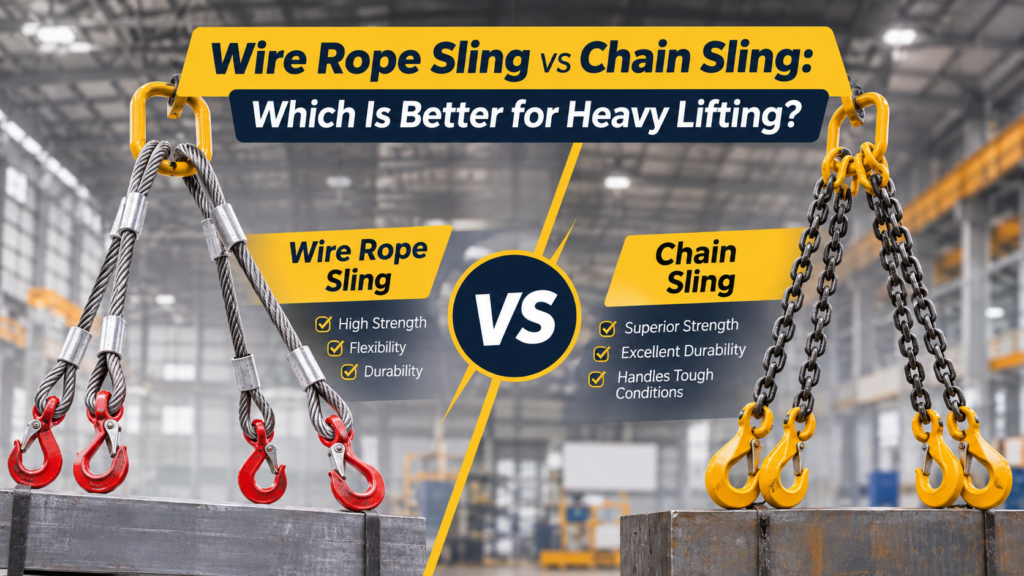
Heavy lifting operations are an essential part of industries such as construction, manufacturing, steel production, warehousing, shipping, and infrastructure development. Selecting the right lifting sling is important for ensuring safe material handling, improving operational efficiency, and reducing workplace risks.
Two commonly used lifting solutions are wire rope slings and chain slings. Both are designed to lift and move heavy loads, but they differ in construction, flexibility, durability, load-handling capabilities, and applications.
Choosing between a wire rope sling and a chain sling depends on several factors, including load weight, lifting environment, temperature conditions, frequency of use, and budget.
In this blog, SVIBO Industries explains the differences between wire rope slings and chain slings, their advantages, applications, and important factors to consider when selecting the right lifting equipment for heavy-duty industrial operations.
What Is a Wire Rope Sling?
A wire rope sling is a flexible lifting accessory manufactured using multiple steel wires twisted together to form strands, which are then laid around a central core. It is commonly used with cranes, hoists, and other lifting equipment to handle heavy industrial loads.
Wire rope slings are available in different configurations, including single-leg, double-leg, three-leg, and four-leg arrangements.
Key Features of Wire Rope Slings
- Manufactured using high-strength steel wires.
- Available in different diameters and configurations.
- Offers good flexibility for various lifting applications.
- Suitable for handling heavy industrial loads.
- Provides good resistance to abrasion when properly selected.
- Available with different end fittings, including hooks, thimbles, and eyes.
Common Applications of Wire Rope Slings
Wire rope slings are widely used in:
- Construction and infrastructure projects.
- Steel and metal fabrication industries.
- Shipping and port operations.
- Manufacturing plants.
- Heavy machinery lifting.
- Industrial equipment transportation.
- Offshore and marine lifting applications.
What Is a Chain Sling?
A chain sling is a heavy-duty lifting accessory made from high-strength alloy steel chains and suitable connecting components. It is commonly used for lifting, positioning, and transporting heavy loads in demanding industrial environments.
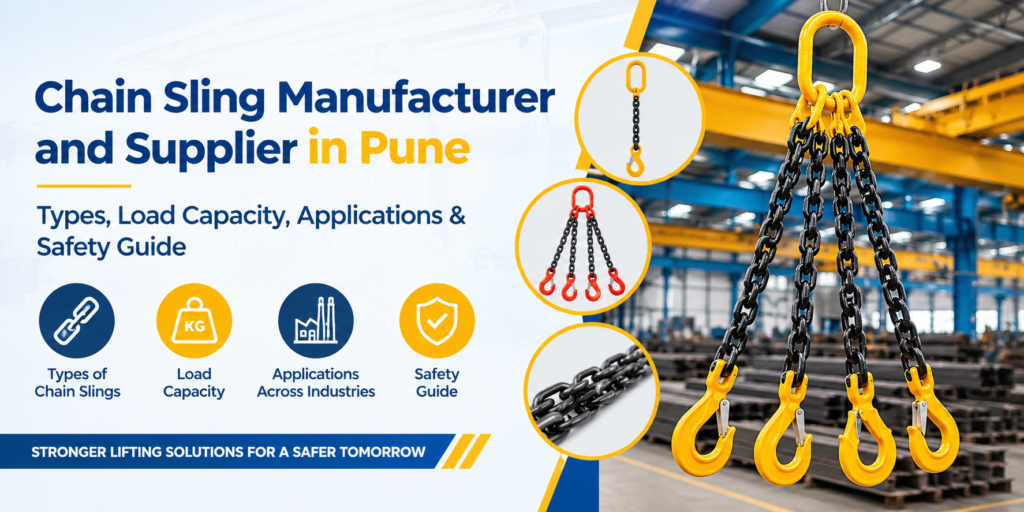
Chain slings are available in single-leg, double-leg, three-leg, and four-leg configurations. Their design allows businesses to select suitable arrangements based on load shape, weight, and lifting requirements.
Key Features of Chain Slings
- Manufactured using high-strength alloy steel.
- Designed for demanding industrial lifting operations.
- Available in different chain grades and capacities.
- Can be configured with hooks, master links, and connecting links.
- Suitable for applications involving higher operating temperatures within specified limits.
- Individual components can be inspected and replaced according to manufacturer specifications.
Common Applications of Chain Slings
Chain slings are commonly used in:
- Heavy engineering industries.
- Steel manufacturing plants.
- Construction and infrastructure projects.
- Foundries and metal processing facilities.
- Machinery installation and maintenance.
- Shipbuilding and industrial fabrication.
- Heavy equipment handling.
Wire Rope Sling vs Chain Sling: Key Differences
Although both lifting accessories are designed for heavy-duty applications, they offer different performance characteristics.
| Comparison Factor | Wire Rope Sling | Chain Sling |
| Material | Steel wire strands | Alloy steel chain |
| Flexibility | Generally more flexible | Comparatively less flexible |
| Weight | Often lighter for equivalent applications | Generally heavier |
| Abrasion Resistance | Depends on rope construction and protection | Generally offers good resistance |
| Temperature Suitability | Depends on rope construction and fittings | Suitable for specified elevated-temperature applications |
| Maintenance | Requires inspection for broken wires, corrosion and deformation | Requires inspection for wear, cracks and deformation |
| Repairability | Generally requires specialized repair or replacement | Approved components may be replaceable |
| Applications | Construction, marine and industrial lifting | Heavy engineering, foundries and industrial lifting |
Note: Actual lifting capacity and performance depend on the sling design, material grade, configuration, condition, manufacturer specifications, and applicable safety standards.
1. Load Capacity and Heavy Lifting Performance
Load capacity is one of the most important considerations when selecting a lifting sling.
Wire Rope Sling:
Wire rope slings are available in different constructions and diameters to accommodate a wide range of industrial lifting requirements. Their flexibility makes them suitable for handling different load shapes and configurations.
Chain Sling:
Chain slings are manufactured using high-strength alloy steel and are available in different chain grades and sizes. They are suitable for demanding lifting operations where the correct chain grade and configuration are selected.
Which Is Better?
Both can handle heavy loads when properly designed and rated. The correct choice should be based on the required Working Load Limit (WLL), sling angle, lifting configuration, and application.
2. Flexibility and Ease of Handling
Flexibility is another important factor, particularly when lifting irregularly shaped or delicate industrial loads.
Wire Rope Sling:
Wire rope slings generally provide better flexibility, allowing them to adapt to different lifting arrangements. They are useful when the lifting operation requires flexibility around suitable load contact points.
Chain Sling:
Chain slings are comparatively rigid but provide excellent versatility through different configurations and compatible lifting attachments.
Which Is Better?
Wire rope slings are generally preferable when greater flexibility is required. Chain slings are suitable when a robust, adjustable lifting arrangement is needed.
3. Durability and Resistance to Damage
Industrial lifting accessories are frequently exposed to rough handling, sharp surfaces, dust, moisture, and demanding operating conditions.
Wire Rope Sling:
Wire rope slings offer good durability when selected and maintained correctly. However, broken wires, corrosion, kinks, crushing, and abrasion can affect their safe working condition.
Chain Sling:
Chain slings are designed for demanding industrial environments. They offer good resistance to abrasion, but excessive wear, stretching, cracks, and deformation can compromise their strength.
Which Is Better?
Chain slings may be preferable in applications involving repeated contact with rough industrial surfaces. However, both types require regular inspection and proper handling.
4. Temperature Resistance
Temperature conditions can significantly influence lifting sling performance.
Wire Rope Sling:
High temperatures can affect wire rope strength, lubrication, and certain core materials. The suitability of a wire rope sling must be verified against manufacturer specifications.
Chain Sling:
Suitable alloy steel chain slings can be used in specified elevated-temperature environments. However, their Working Load Limit may need to be reduced depending on the operating temperature and applicable manufacturer guidelines.
Which Is Better?
Chain slings are often preferred for certain high-temperature industrial applications, such as foundries and metal processing plants, provided the chain is specifically rated for those conditions.
5. Maintenance and Inspection Requirements
Regular maintenance is essential for both wire rope and chain slings to ensure safe lifting operations.
Wire Rope Sling Inspection:
- Check for broken or protruding wires.
- Inspect for corrosion and rust.
- Look for kinks, crushing, and birdcaging.
- Examine end fittings and connections.
- Check for signs of heat or chemical damage.
Chain Sling Inspection:
- Check for cracks and deformation.
- Inspect chain links for excessive wear.
- Examine hooks and safety latches.
- Check master links and connecting components.
- Verify identification tags and rated capacities.
Which Is Better?
Both require systematic inspection. Chain slings may offer the advantage of replacing certain approved components, while wire rope slings generally require specialized assessment and repair or replacement.
6. Cost and Long-Term Value
Cost is an important consideration for businesses purchasing industrial lifting accessories.
Wire rope slings may be economical for several general-purpose lifting applications. Chain slings may involve a higher initial investment depending on chain grade, configuration, and fittings.
However, the total cost should include:
- Initial purchase price.
- Maintenance and inspection expenses.
- Replacement component availability.
- Expected service life under actual operating conditions.
- Application-specific safety requirements.
The most economical option is not necessarily the cheapest product. Businesses should prioritize suitability, quality, safety, and long-term performance.
Wire Rope Sling vs Chain Sling: Which One Should You Choose?
The right choice depends on your lifting requirements and industrial working environment.
| Application | Recommended Sling |
| General industrial lifting | Wire Rope Sling or Chain Sling |
| Heavy machinery handling | Based on load and lifting arrangement |
| Rough surface contact | Suitable Chain Sling with proper protection |
| Flexible lifting arrangements | Wire Rope Sling |
| Certain high-temperature applications | Temperature-rated Chain Sling |
| Construction and infrastructure | Both, depending on application |
| Steel and metal processing | Suitable Chain Sling or rated Wire Rope Sling |
Important: These are general selection guidelines, not universal recommendations. Always verify the rated capacity, sling angle, load distribution, environmental conditions, and manufacturer instructions before lifting.
Important Safety Tips for Using Lifting Slings
Regardless of whether you use a wire rope sling or a chain sling, following proper safety practices is essential.
- Check the Working Load Limit: Never exceed the rated capacity of the sling.
- Inspect Before Use: Examine the sling and its components for visible damage.
- Use Proper Sling Angles: Ensure the sling angle and resulting leg tension remain within approved limits.
- Avoid Shock Loading: Lift loads smoothly without sudden jerks.
- Protect Against Sharp Edges: Use suitable protective materials where required.
- Use Compatible Fittings: Ensure hooks, shackles, and connecting components are appropriately rated.
- Avoid Unauthorized Repairs: Never weld, heat, or modify lifting slings without manufacturer-approved procedures.
- Store Properly: Keep lifting accessories in suitable storage conditions to minimize corrosion and damage.
- Follow Inspection Standards: Arrange periodic inspections by competent personnel.
- Train Operators: Ensure workers understand correct sling selection and safe lifting procedures.
How to Choose a Reliable Lifting and Rigging Equipment Manufacturer in India?
Selecting a dependable manufacturer or supplier is important for businesses that regularly perform industrial lifting operations.
Before purchasing wire rope slings or chain slings, consider the following factors:
1. Product Quality: Check the materials, manufacturing quality, and specifications of the lifting accessories.
2. Capacity and Configuration Options: Choose a supplier that can guide you in selecting suitable sling capacities and configurations.
3. Safety Compliance: Verify applicable standards, inspection documentation, and product identification details.
4. Range of Products: Consider suppliers offering different lifting and rigging accessories, including wire rope slings, chain slings, shackles, hooks, and lifting attachments.
5. Technical Knowledge: An experienced supplier should understand industrial lifting applications and provide appropriate product guidance.
6. After-Sales Support: Availability of technical assistance, inspection guidance, and compatible replacement components can support long-term equipment reliability.
SVIBO Industries focuses on industrial lifting and rigging equipment solutions, helping businesses identify suitable products for their material-handling requirements.
Why Choose SVIBO Industries for Lifting and Rigging Equipment?
SVIBO Industries understands the importance of dependable lifting and rigging accessories in industrial environments. Selecting suitable equipment is essential for safe material handling, efficient operations, and long-term performance.
Whether your application involves construction, manufacturing, engineering, or heavy industrial operations, choosing the correct lifting accessories is an important step towards achieving reliable lifting performance.
Businesses should evaluate product specifications, load requirements, operating conditions, and safety documentation before selecting any lifting equipment.
Conclusion
Both wire rope slings and chain slings play an important role in modern industrial lifting operations. Wire rope slings are generally preferred for applications requiring greater flexibility and versatile lifting arrangements, while chain slings are suitable for demanding industrial environments, including certain high-temperature applications.
There is no single solution that works best for every lifting requirement. The ideal choice depends on load capacity, working conditions, lifting configuration, durability requirements, and safety considerations.
By selecting quality lifting accessories and following proper inspection practices, businesses can improve material-handling efficiency and support safer industrial operations.
SVIBO Industries aims to support industrial businesses with lifting and rigging equipment solutions that address diverse material-handling requirements.
Frequently Asked Questions (FAQs)
1. What is the main difference between a wire rope sling and a chain sling?
The main difference is their construction. Wire rope slings are made from twisted steel wire strands, whereas chain slings are manufactured using high-strength alloy steel links. Wire rope slings generally offer greater flexibility, while chain slings are suitable for demanding industrial applications.
2. Which sling is better for heavy lifting?
Both wire rope slings and chain slings can be used for heavy lifting. The right option depends on the load weight, lifting arrangement, operating environment, and rated Working Load Limit.
3. Are chain slings suitable for high-temperature applications?
Certain alloy steel chain slings are suitable for elevated-temperature applications. However, their load capacity may need to be reduced according to manufacturer specifications and applicable standards.
4. How often should lifting slings be inspected?
Lifting slings should be visually inspected before each use and undergo periodic detailed inspections according to applicable standards, manufacturer recommendations, and operating conditions.
5. What is the Working Load Limit (WLL) of a lifting sling?
Working Load Limit is the maximum load that a lifting sling is rated to support under specified conditions. It depends on the sling design, material, configuration, and lifting arrangement.
6. Can damaged wire rope slings or chain slings be repaired?
Damaged lifting slings should be removed from service and assessed by competent personnel. Repairs or component replacements must follow approved manufacturer procedures. Unauthorized welding, heating, or modification should never be performed.
7. Where can I find a reliable lifting and rigging equipment manufacturer in India?
Look for a manufacturer or supplier offering quality lifting accessories, suitable product specifications, inspection documentation, and technical support. SVIBO Industries provides industrial lifting and rigging equipment solutions for different material-handling requirements.