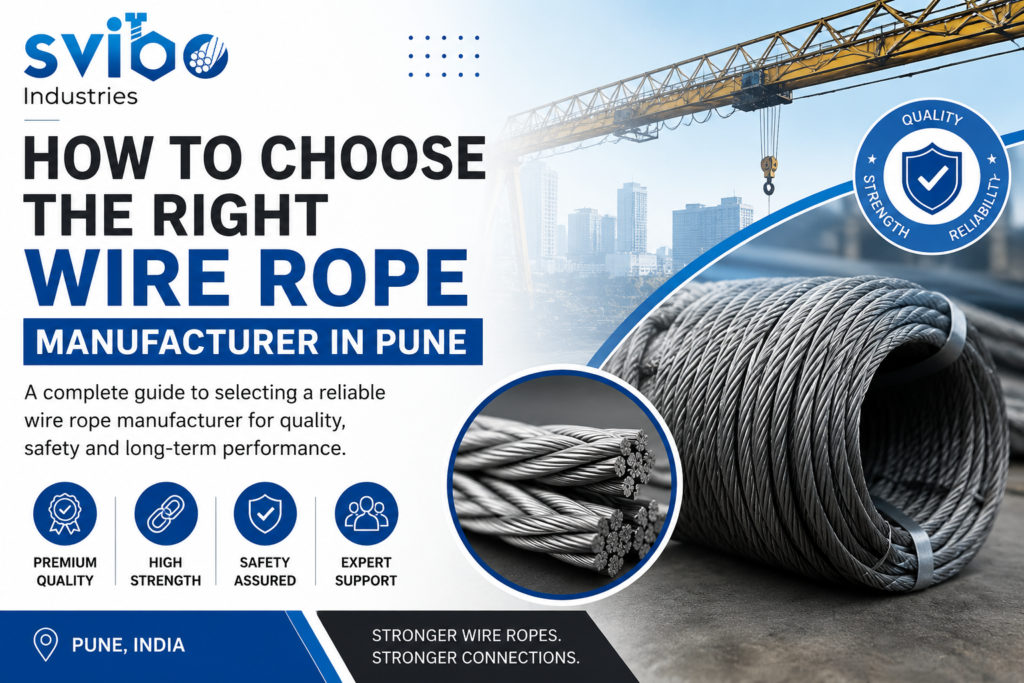
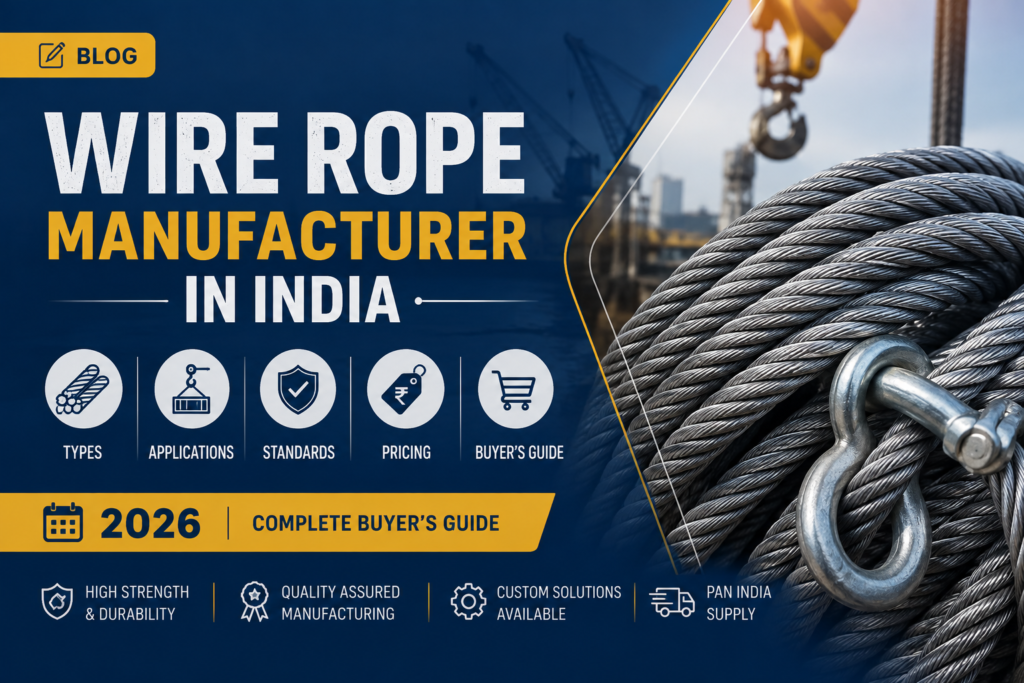
Choosing the right wire rope is critical for safe and efficient lifting, material handling, construction, mining, marine, and industrial operations. Wire ropes are engineered lifting components designed to withstand tensile loads, bending, abrasion, and repeated operating cycles.
For businesses searching for a Wire Rope Manufacturer in India, the decision should not be based on price alone. Rope construction, diameter, material, core type, breaking strength, working load limit, lubrication, application, and applicable standards all influence the right selection.
This comprehensive guide explains the major types of steel wire ropes, their applications, construction, pricing factors, standards, maintenance requirements, and how to select a reliable Wire Rope Supplier in India.
What Is a Wire Rope?
Wire rope is a flexible mechanical component manufactured by twisting multiple steel wires into strands and then laying those strands around a central core.
A typical wire rope consists of three main elements:
- Individual steel wires
- Strands
- Core
The combination of these elements determines the rope’s strength, flexibility, resistance to abrasion, fatigue performance, and suitability for different applications.
Wire ropes are commonly used with:
- EOT cranes
- Overhead cranes
- Gantry cranes
- Mobile cranes
- Tower cranes
- Hoists
- Elevators
- Winches
- Construction equipment
- Mining equipment
- Marine equipment
How Is Steel Wire Rope Constructed?
Understanding wire rope construction helps buyers select the correct product.
1. Wires
Individual steel wires form the basic building blocks of the rope. Wire diameter, material properties, and surface finish influence the overall performance of the rope.
2. Strands
Multiple wires are helically arranged to form strands. Different strand constructions provide different combinations of strength, flexibility, and abrasion resistance.
3. Core
The strands are laid around a central core that supports the rope and maintains its shape.
Common core types include:
- Fiber Core
- Independent Wire Rope Core (IWRC)
- Wire Strand Core
The core selection depends on the application, required flexibility, crushing resistance, temperature, and operating conditions.
Types of Wire Rope
There are several wire rope constructions available for industrial applications.
1. 6×19 Wire Rope
A 6×19 construction contains six strands with approximately 19 wires per strand.
It provides a balance between strength, flexibility, and abrasion resistance and is commonly used for general lifting and industrial applications.
2. 6×37 Wire Rope
The 6×37 construction contains six strands with approximately 37 wires per strand.
Its greater number of smaller wires generally provides increased flexibility compared with coarser constructions.
Typical applications include:
- Crane ropes
- Hoists
- Winches
- Material handling equipment
3. 8×19 Wire Rope
8×19 constructions contain eight strands and are used in applications where flexibility and smooth operation are important.
They are commonly associated with:
- Elevators
- Hoisting equipment
- Cranes
- Material handling systems
4. Rotation-Resistant Wire Rope
Rotation-resistant ropes are designed to reduce the tendency of the rope to rotate under load.
They are used in applications where load rotation can create operational or safety problems.
5. Galvanized Wire Rope
Galvanized wire ropes have a zinc coating that provides improved resistance to corrosion compared with uncoated ropes.
They are commonly selected for:
- Outdoor lifting
- Marine environments
- Construction
- Infrastructure
- General industrial applications
6. Stainless Steel Wire Rope
Stainless steel wire ropes offer high corrosion resistance and are used where environmental exposure or hygiene requirements make stainless steel appropriate.
Applications can include:
- Marine equipment
- Food processing
- Architectural systems
- Chemical environments
- Specialized industrial equipment
Wire Rope Construction Comparison
| Construction | Flexibility | Abrasion Resistance | Common Applications |
| 6×19 | Medium | High | General lifting, cranes |
| 6×37 | High | Medium | Hoists, cranes, winches |
| 8×19 | High | Medium | Elevators, cranes, hoists |
| Rotation-resistant | Application-specific | Application-specific | Specialized lifting |
| Galvanized | Depends on construction | Good | Outdoor and marine applications |
| Stainless steel | Depends on construction | Application-specific | Corrosive environments |
The actual performance depends on rope diameter, grade, core, lay, construction, operating conditions, and manufacturer specifications.
Wire Rope Core Types
The core is an important part of a wire rope because it supports the strands and helps maintain the rope’s shape.
Fiber Core
Fiber cores can provide flexibility and are commonly used where flexibility is important.
However, their suitability can be affected by temperature, crushing loads, and environmental conditions.
Independent Wire Rope Core (IWRC)
IWRC provides a wire-based core that generally offers improved strength and resistance to crushing and higher operating temperatures compared with many fiber-core constructions.
It is commonly used for demanding crane and lifting applications.
Wire Strand Core
Wire strand cores are constructed from wire strands and can provide useful strength and structural support depending on the application.
Wire Rope Applications in Different Industries
A reliable Wire Rope Manufacturer in India may supply ropes for a wide range of industrial sectors.
EOT and Overhead Cranes
Wire ropes are essential components in many crane hoisting systems.
They may be used for:
- Load lifting
- Hoisting mechanisms
- Trolley systems
- Material handling
Construction Industry
Construction equipment uses wire ropes for lifting and positioning heavy materials and machinery.
Typical applications include:
- Tower cranes
- Mobile cranes
- Winches
- Hoists
- Material lifting systems
Mining Industry
Mining operations can require high-strength wire ropes for demanding lifting and hauling applications.
Marine Industry
Marine applications may require wire ropes designed for corrosion resistance, fatigue resistance, and exposure to harsh environmental conditions.
Oil and Gas
Specialized wire ropes may be used in offshore and onshore lifting and material-handling operations.
Elevators
Elevator systems use specialized wire rope constructions designed for repeated bending and high-cycle operation.
Manufacturing and Engineering
Industrial plants use wire ropes for:
- Machine handling
- Die handling
- Equipment installation
- Crane systems
- Winching operations
Wire Rope for Cranes: What Should You Consider?
When selecting wire rope for an EOT crane or other lifting equipment, several factors need to be evaluated.
Important Parameters
- Rope diameter
- Rope construction
- Core type
- Rope grade
- Minimum breaking force
- Working load
- Drum diameter
- Sheave diameter
- Number of bends
- Operating speed
- Lifting frequency
- Environment
- Lubrication requirements
Using a rope that does not match the crane manufacturer’s specifications can affect safety and service life.
Wire Rope Breaking Strength and Working Load Limit
Breaking strength refers to the load at which a rope may fail under a specified test condition.
The Working Load Limit (WLL) is the maximum load that the rope or lifting system is rated to handle under specified conditions.
These values should not be treated as interchangeable.
A wire rope’s allowable working load depends on factors including:
- Minimum breaking force
- Safety factor
- Rope construction
- Hitch/configuration
- Application
- Applicable standards
- Manufacturer recommendations
For lifting applications, always follow the manufacturer’s rated capacity and applicable safety requirements rather than calculating capacity from breaking strength alone.
Wire Rope Price in India
The price of wire rope varies considerably depending on specifications and market conditions.
Major Factors Affecting Wire Rope Price
| Pricing Factor | Why It Matters |
| Rope diameter | Larger diameter generally requires more material |
| Construction | Different constructions have different manufacturing costs |
| Core | Fiber and wire cores have different costs and performance |
| Material | Carbon steel, galvanized and stainless steel differ in price |
| Grade | Higher-performance materials may cost more |
| Length | Longer rope quantities increase total cost |
| Coating | Galvanizing and specialized coatings affect pricing |
| Lubrication | Specialized lubrication can influence cost |
| Certification | Testing and documentation requirements may affect price |
| Quantity | Bulk purchases may have different commercial terms |
Therefore, it is better to request a quotation based on complete technical specifications rather than comparing prices per metre without considering construction and grade.
How to Choose a Reliable Wire Rope Manufacturer in India
Selecting the right manufacturer can help ensure product consistency, technical support, and long-term performance.
1. Check Manufacturing Experience
Look for a manufacturer with experience supplying wire ropes for your specific industry or application.
2. Evaluate Product Range
A capable manufacturer or supplier should be able to provide different:
- Constructions
- Diameters
- Core types
- Grades
- Finishes
- Lengths
3. Check Quality Control
Ask about raw material control, manufacturing processes, testing, inspection, and product traceability.
4. Verify Technical Documentation
Depending on your application, documentation may include:
- Test certificates
- Material certificates
- Product specifications
- Breaking force information
- Compliance documentation
5. Consider Custom Requirements
Industrial applications may require specific lengths, constructions, cores, finishes, or end terminations.
6. Evaluate Delivery Capability
For critical lifting applications, consistent availability and timely delivery can be important factors.
7. Assess Technical Support
A good Wire Rope Supplier in India should be able to help customers understand rope selection, installation, inspection, and replacement requirements.
Wire Rope Standards and Quality
Wire rope should be selected and manufactured according to the standards applicable to the intended product and application.
Depending on the market and rope type, buyers may encounter standards such as:
- IS standards
- EN standards
- ISO standards
- ASTM specifications
- ASME requirements
- Crane manufacturer’s specifications
The applicable standard should always be confirmed for the specific wire rope construction and intended application.
When purchasing industrial wire rope, ask the manufacturer to provide relevant product documentation and testing information.
Wire Rope Inspection and Maintenance
Regular inspection is essential for maintaining lifting safety.
A wire rope should be inspected for visible signs of deterioration, including:
- Broken wires
- Excessive wear
- Corrosion
- Kinking
- Crushing
- Birdcaging
- Heat damage
- Diameter reduction
- Rope deformation
- Damaged end connections
- Poor lubrication
The inspection frequency should be determined according to applicable regulations, manufacturer instructions, operating conditions, and usage intensity.
How to Extend Wire Rope Service Life
Proper handling and maintenance can help improve wire rope performance.
Follow Correct Installation Procedures
Incorrect installation can cause kinking, twisting, or uneven winding.
Maintain Proper Lubrication
Appropriate lubrication helps reduce friction and protect against corrosion. The lubricant should be compatible with the rope and operating environment.
Inspect Sheaves and Drums
Damaged or incorrectly sized sheaves and drums can accelerate rope deterioration.
Avoid Shock Loading
Sudden loading can create forces significantly greater than normal static loads.
Prevent Contact With Sharp Edges
Sharp edges can damage individual wires and accelerate rope wear.
Store Correctly
Wire rope should be stored in a clean, dry location and protected from conditions that can cause corrosion or contamination.
Wire Rope vs Chain Sling
Both wire ropes and chain slings are widely used for lifting applications, but their characteristics differ.
| Feature | Wire Rope | Chain Sling |
| Flexibility | Generally high | Good |
| Weight | Generally lighter for comparable applications | Generally heavier |
| Abrasion resistance | Good, application-dependent | Generally high |
| Inspection | Requires detailed visual inspection | Requires link and component inspection |
| Configuration | Highly versatile | Highly versatile |
| Crane applications | Very common | Common |
| Corrosion resistance | Depends on finish | Depends on material/coating |
| High-cycle bending | Specialized constructions available | Not typically the primary advantage |
The correct choice depends on the lifting equipment, load, operating cycle, environment, and manufacturer’s recommendations.
Common Mistakes When Buying Wire Rope
Avoid these common purchasing mistakes:
Choosing Only by Price
A cheaper rope may not provide the required construction, breaking force, service life, or application suitability.
Ignoring the Core
Fiber core and IWRC ropes behave differently under load and during bending.
Selecting the Wrong Diameter
Rope diameter must be compatible with the crane, sheaves, drums, and manufacturer’s specifications.
Ignoring Operating Conditions
Temperature, corrosion, abrasion, bending frequency, and shock loading can significantly affect rope performance.
Not Checking Documentation
For critical lifting applications, appropriate certification and traceability can be essential.
Mixing Components Without Verification
The rope, end termination, sheaves, drum, and lifting system should be compatible and appropriately rated.
Wire Rope Buying Checklist
Before ordering wire rope, provide your manufacturer or supplier with:
- Required rope diameter
- Required length
- Rope construction
- Core type
- Material/grade
- Galvanized or ungalvanized requirement
- Minimum breaking force requirement
- Application
- Crane or equipment type
- Drum diameter
- Sheave diameter
- Operating environment
- End termination requirements
- Testing/certification requirements
Providing complete specifications allows the Wire Rope Manufacturer in India to recommend a more suitable product.
Why Choose an Experienced Wire Rope Supplier in India?
An experienced supplier can provide more than just the physical product.
A dependable supplier can help with:
- Product selection
- Technical specifications
- Rope construction
- Diameter selection
- Core selection
- Application suitability
- Testing documentation
- Bulk supply
- Custom lengths
- Replacement requirements
- Technical support
For businesses with recurring lifting requirements, establishing a relationship with a reliable Wire Rope Supplier in India can simplify procurement and help maintain consistency across operations.
Frequently Asked Questions About Wire Rope
1. What is a wire rope used for?
Wire ropes are used for lifting, pulling, suspension, hauling, and material handling. Common applications include cranes, hoists, elevators, winches, construction equipment, mining systems, and marine operations.
2. Which wire rope is best for cranes?
The appropriate wire rope depends on the crane type, rope diameter, construction, core, drum and sheave dimensions, lifting capacity, bending cycles, operating speed, and manufacturer’s specifications.
3. What is the difference between 6×19 and 6×37 wire rope?
Both have six strands, but their wire distribution differs. 6×19 generally provides a balance of strength and abrasion resistance, while 6×37 generally offers greater flexibility due to its greater number of smaller wires.
4. What is IWRC in wire rope?
IWRC stands for Independent Wire Rope Core. It is a wire-based core that provides structural support and can offer increased strength and resistance to crushing compared with many fiber-core constructions.
5. What affects wire rope price in India?
Wire rope price depends on diameter, construction, core type, material, grade, finish, length, quantity, certification requirements, and market conditions.
6. How do I choose a wire rope supplier in India?
Compare suppliers based on manufacturing experience, product range, quality control, testing, certifications, technical expertise, customization capability, delivery performance, and after-sales support.
7. What is galvanized wire rope?
Galvanized wire rope has a zinc coating designed to improve corrosion resistance. It is commonly considered for outdoor, marine, construction, and other environments where corrosion protection is important.
8. How often should wire rope be inspected?
Wire rope should be inspected before use and at intervals determined by applicable regulations, manufacturer recommendations, operating conditions, and frequency of use. Damaged ropes should be removed from service and assessed by a competent person.
9. Can wire rope be used for EOT cranes?
Yes. Wire ropes are widely used in EOT crane hoisting systems. However, the rope must match the crane manufacturer’s specifications for construction, diameter, core, capacity, drum, sheaves, and operating conditions.
10. How can I find the right Wire Rope Manufacturer in India?
Evaluate manufacturers based on product quality, manufacturing capability, technical expertise, applicable standards, testing documentation, product range, customization options, delivery capability, and customer support.
Conclusion
Selecting the right wire rope requires careful consideration of construction, diameter, core, material, breaking strength, operating conditions, and equipment compatibility. A quality product can contribute to safer lifting operations, improved reliability, and longer service life when it is correctly selected and maintained.
Whether you are purchasing wire rope for an EOT crane, gantry crane, hoist, elevator, winch, construction equipment, mining application, or marine operation, work with an experienced Wire Rope Manufacturer in India that can provide appropriate technical specifications, testing documentation, and application support.
For businesses looking for a dependable Wire Rope Supplier in India, compare suppliers on quality, technical capability, certifications, product availability, customization, and after-sales service—not price alone.