When it comes to lifting and material handling, choosing the right chain sling is essential for safety, load stability, durability, and operational efficiency. Chain slings are widely used across construction, engineering, steel, manufacturing, shipbuilding, logistics, and heavy fabrication industries.
With several manufacturers and suppliers available in the market, identifying the Top Chain Sling Manufacturers in India requires more than comparing prices. Buyers should evaluate chain grade, working load limit, configuration, certifications, manufacturing quality, customization options, and after-sales support.
This comprehensive guide explains chain sling types, applications, pricing factors, safety considerations, and important points to consider before selecting a manufacturer or supplier.
What Is a Chain Sling?
A chain sling is a heavy-duty lifting assembly made from high-strength alloy steel chains and lifting components such as master links, hooks, connecting links, and shortening devices.
Chain slings are used to connect a lifting load to equipment such as:
- EOT cranes
- Overhead cranes
- Mobile cranes
- Gantry cranes
- Jib cranes
- Hoists
- Material handling systems
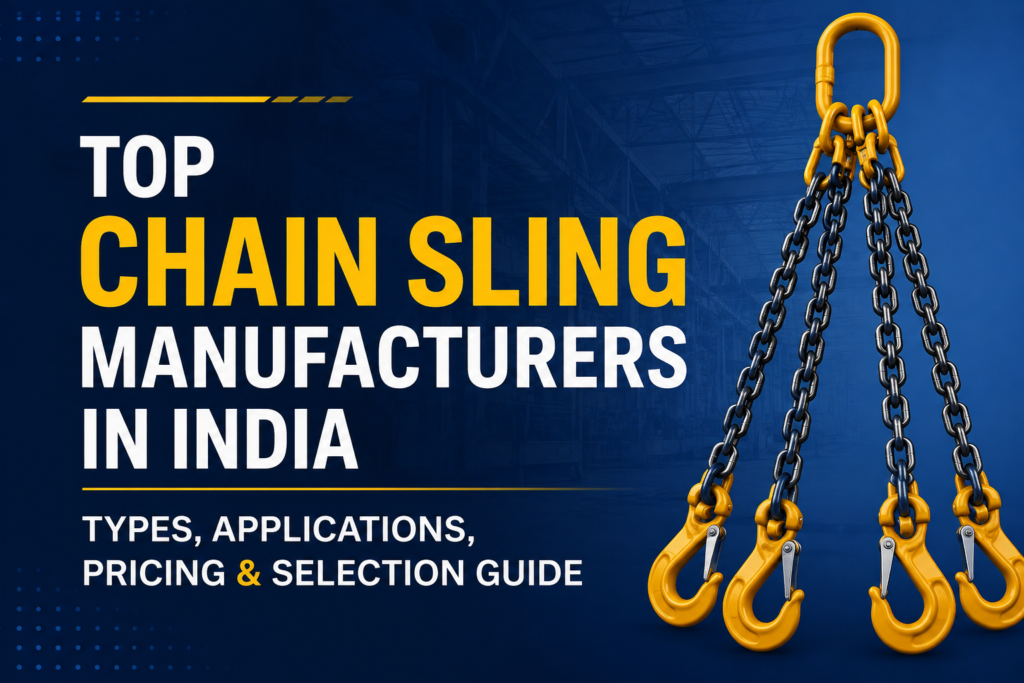
Depending on the application, chain slings can be manufactured in single-leg, double-leg, triple-leg, and four-leg configurations.
Their flexibility and resistance to abrasion make them suitable for demanding industrial lifting environments.
Why Choose a Reliable Chain Sling Manufacturer in India?
The quality of a chain sling directly affects lifting safety. A professionally manufactured sling should be designed according to the required load, configuration, chain grade, lifting angle, and application.
A reliable manufacturer can provide:
- High-strength alloy steel chains
- Properly rated lifting components
- Tested assemblies
- Appropriate working load limits
- Identification and traceability
- Customized sling configurations
- Inspection and testing documentation
- Technical assistance
- Replacement and maintenance support
When evaluating the Top Chain Sling Manufacturers in India, businesses should therefore look beyond the purchase price and assess the complete product and service offering.
Types of Chain Slings
Chain slings are available in different configurations depending on the load and lifting requirements.
1. Single-Leg Chain Sling
A single-leg chain sling consists of one chain leg with appropriate lifting hooks and master links.
Applications include:
- General material handling
- Machine lifting
- Fabrication
- Maintenance operations
- Construction lifting
It is suitable when the lifting point and load configuration allow a single lifting connection.
2. Two-Leg Chain Sling
Two-leg chain slings provide improved load distribution and are commonly used for lifting equipment and fabricated structures.
They can be configured with different hook arrangements depending on the application.
3. Three-Leg Chain Sling
Three-leg chain slings are designed for applications where multiple lifting points are required. They can provide greater flexibility when lifting large or irregularly shaped loads.
4. Four-Leg Chain Sling
Four-leg chain slings are generally used for heavy and large loads requiring multiple lifting points.
Typical applications include:
- Heavy machinery
- Structural components
- Industrial equipment
- Steel fabrication
- Large assemblies
The actual lifting capacity depends on factors such as chain size, grade, sling configuration, lifting angle, and connection method.
Common Chain Sling Grades
The chain grade is one of the most important factors when selecting a chain sling.
Grade 80 Chain Slings
Grade 80 alloy steel chain is widely used for industrial lifting applications. It provides a good combination of strength, durability, and cost-effectiveness.
Grade 100 Chain Slings
Grade 100 chain provides higher strength than Grade 80 for comparable chain sizes. This can allow certain lifting applications to achieve higher working load limits while maintaining a practical chain size.
Grade 120 Chain Slings
Grade 120 chains are designed for applications requiring very high strength-to-weight performance. Availability, configuration, and suitability should be evaluated based on the manufacturer’s specifications and applicable standards.
Important: Chain grade alone does not determine the safe lifting capacity. The complete sling assembly and its configuration must be considered.
Chain Sling Applications in Different Industries
Chain slings are used in numerous industries because of their flexibility, strength, and resistance to harsh working conditions.
Construction Industry
Construction companies use chain slings for lifting:
- Steel structures
- Pipes
- Construction equipment
- Concrete components
- Machinery
Steel Industry
Steel plants require robust lifting solutions for handling:
- Steel coils
- Plates
- Structural steel
- Machinery
- Heavy components
Engineering and Manufacturing
Manufacturing facilities use chain slings to move heavy machines, components, dies, motors, and fabricated assemblies.
Shipbuilding and Marine Applications
Chain slings can be used for handling heavy marine components and assemblies where robust lifting equipment is required.
Foundries
Foundries often operate in demanding environments involving heat, abrasion, and heavy loads. Properly selected alloy chain slings can be suitable for several material-handling operations.
Power and Infrastructure Projects
Heavy equipment and structural components used in power and infrastructure projects often require certified lifting accessories capable of handling substantial loads.
Chain Sling Pricing in India
One of the most common questions buyers ask is: How much does a chain sling cost in India?
There is no single standard price because chain sling pricing depends on several technical specifications.
Key Factors Affecting Chain Sling Price
| Factor | Impact on Price |
| Chain diameter | Larger chains generally cost more |
| Chain grade | Higher grades can increase cost |
| Sling length | Longer assemblies require more chain |
| Number of legs | Multi-leg slings generally cost more |
| Hooks and fittings | Component selection affects overall cost |
| Working Load Limit | Higher capacity can require stronger components |
| Customization | Special configurations may increase manufacturing cost |
| Testing & certification | Documentation and testing can affect pricing |
| Quantity | Bulk orders may receive different commercial pricing |
Instead of choosing a chain sling solely on the lowest quotation, buyers should compare capacity, quality, certification, components, service life, and compliance.
How to Select the Right Chain Sling
Selecting the correct sling requires a systematic evaluation of the lifting application.
1. Determine the Load Weight
Start by establishing the accurate weight of the load.
Never select a sling based on an estimated load weight when the actual weight is available.
2. Check the Load Dimensions
The dimensions and shape of the load determine the required sling length and configuration.
3. Identify the Lifting Points
Check whether the load has:
- Lifting lugs
- Eye bolts
- Hooks
- Shackles
- Other designated lifting points
4. Select the Appropriate Chain Grade
Choose the chain grade based on the required working load limit and manufacturer’s recommendations.
5. Consider the Sling Angle
For multi-leg slings, the angle between the sling legs can significantly affect the load carried by each leg.
As the sling angle changes, the tension in the sling legs changes. Therefore, working load limits must be determined according to the manufacturer’s rated configurations.
6. Select Suitable Hooks and Fittings
Hooks, master links, connecting links, and other components should have compatible ratings and dimensions.
7. Consider the Working Environment
Evaluate whether the sling will be exposed to:
- Heat
- Chemicals
- Sharp edges
- Abrasion
- Corrosion
- Outdoor conditions
The operating environment can influence the appropriate lifting accessory and inspection requirements.
Chain Sling Safety and Inspection
Even a high-quality chain sling can become unsafe if it is damaged, improperly used, or overloaded.
Regular inspection should look for:
- Cracked or deformed hooks
- Excessive chain wear
- Bent links
- Stretching
- Corrosion
- Gouges or cuts
- Damaged connecting components
- Missing identification tags
- Heat damage
A sling showing significant damage should be removed from service and evaluated by a competent person according to the applicable safety procedures.
Never Exceed the Rated Working Load Limit
The rated working load limit should always be followed. Factors such as sling angle, hitch type, load distribution, and connection method can affect the allowable capacity.
Chain Sling Standards and Certification
Industrial lifting accessories should be manufactured and tested according to relevant standards and applicable regulations.
Depending on the market and application, buyers may encounter standards such as:
- EN standards
- ASME standards
- OSHA requirements
- Applicable Indian Standards
- Manufacturer-specific testing specifications
Before purchasing, ask the manufacturer for relevant test certificates, inspection documentation, product identification, and technical specifications.
The exact standard applicable to a chain sling should be confirmed based on its design, grade, intended application, and market requirements.
Chain Sling Manufacturer vs Supplier: Which Should You Choose?
Both manufacturers and suppliers can be useful, depending on the project.
Direct Manufacturer
Buying directly from a manufacturer may be beneficial when you need:
- Customized sling assemblies
- Large quantities
- Technical consultation
- Specific chain grades
- Special hooks or fittings
- Testing documentation
- Long-term supply
Supplier or Distributor
A supplier may be appropriate when you need:
- Standard products
- Faster availability
- Smaller quantities
- Multiple lifting accessories from different brands
For large industrial projects, working with an experienced manufacturer can provide greater control over specifications and customization.
How to Evaluate the Top Chain Sling Manufacturers in India
Rather than selecting a manufacturer solely based on online rankings, evaluate suppliers against practical criteria.
Manufacturing Capability
Check whether the company has appropriate facilities and processes for manufacturing lifting assemblies.
Product Range
A good manufacturer should offer multiple configurations, chain grades, lengths, and lifting components.
Quality Control
Ask about inspection and testing procedures used during manufacturing.
Technical Expertise
The manufacturer should understand working load limits, sling angles, lifting configurations, and application requirements.
Customization
For specialized lifting operations, customized sling assemblies can be important.
Documentation
Look for appropriate product identification, test certificates, and technical documentation.
After-Sales Support
Good technical support can help with inspections, replacement components, maintenance, and future requirements.
Chain Sling vs Wire Rope Sling
Both chain slings and wire rope slings have their own advantages.
| Feature | Chain Sling | Wire Rope Sling |
| Durability | High | High |
| Flexibility | Good | Excellent |
| Abrasion resistance | Generally high | Application-dependent |
| Inspection | Relatively straightforward | Requires detailed inspection |
| Heavy industrial use | Excellent | Excellent |
| Custom configurations | Available | Available |
| Temperature resistance | Depends on grade/application | Depends on construction and environment |
The best choice depends on load characteristics, operating environment, lifting configuration, and manufacturer recommendations.
Benefits of Using Quality Chain Slings
Choosing a properly designed and manufactured chain sling can provide several advantages:
- High lifting strength
- Good durability
- Flexible configurations
- Resistance to mechanical wear
- Easy storage
- Customizable lengths
- Multiple hook options
- Suitable for demanding industrial environments
However, these benefits depend on proper selection, inspection, handling, and usage.
Why Indian Industries Prefer Locally Manufactured Chain Slings
India has a large manufacturing and infrastructure sector, creating significant demand for industrial lifting accessories.
Working with an established Indian manufacturer can provide advantages such as:
- Faster communication
- Local technical support
- Customized products
- Competitive manufacturing costs
- Easier replacement and servicing
- Shorter supply chains
- Support for bulk requirements
For businesses searching for Top Chain Sling Manufacturers in India, local manufacturing capability combined with quality assurance can be an important selection factor.
Chain Sling Buying Checklist
Before placing an order, buyers should verify:
- Load weight
- Working Load Limit
- Chain grade
- Chain diameter
- Sling length
- Number of legs
- Sling configuration
- Hook type
- Master link specification
- Lifting angle
- Operating environment
- Applicable standards
- Testing requirements
- Certification/documentation
- Manufacturer experience
- Delivery timeline
- After-sales support
This checklist helps avoid selecting a sling based only on price.
Frequently Asked Questions About Chain Slings
1. What is a chain sling used for?
Chain slings are used for lifting and handling heavy loads with cranes, hoists, and other lifting equipment. They are commonly used in construction, manufacturing, steel, engineering, shipbuilding, and infrastructure industries.
2. How do I choose a chain sling?
Choose a chain sling based on the load weight, working load limit, chain grade, chain diameter, sling configuration, lifting angle, load dimensions, lifting points, and operating environment.
3. Which chain grade is best for lifting?
Grade 80 and Grade 100 chains are commonly used for industrial lifting. The appropriate grade depends on the required working load limit, application, configuration, and applicable standards.
4. How much does a chain sling cost in India?
Chain sling prices vary depending on chain diameter, grade, length, number of legs, hooks, fittings, working load limit, customization, testing, and order quantity. Buyers should request a specification-based quotation.
5. What are the different types of chain slings?
Common configurations include single-leg, two-leg, three-leg, and four-leg chain slings. Custom configurations can also be manufactured for specialized lifting applications.
6. Are chain slings suitable for heavy-duty lifting?
Yes. Properly selected alloy steel chain slings are widely used for heavy-duty industrial lifting. The sling must always be used within its rated working load limit and according to the manufacturer’s instructions.
7. How often should chain slings be inspected?
Chain slings should be inspected before use and periodically according to applicable regulations, manufacturer recommendations, and workplace lifting procedures. Any sling showing damage or excessive wear should be removed from service for evaluation.
8. What information should I provide to a chain sling manufacturer?
Provide the manufacturer with the load weight, dimensions, lifting points, required sling length, number of legs, lifting configuration, working environment, lifting equipment, and any required standards or certifications.
9. What is the difference between Grade 80 and Grade 100 chain slings?
Grade 100 chain generally offers a higher strength level than Grade 80 for comparable chain sizes. However, the complete sling assembly and its rated configuration must be considered when determining lifting capacity.
10. How can I find the Top Chain Sling Manufacturers in India?
Compare manufacturers based on product quality, manufacturing capability, chain grades, testing procedures, certifications, customization, technical expertise, delivery capability, and after-sales support rather than relying only on price or online rankings.
Final Thoughts
Selecting a chain sling is an important safety and productivity decision for any industrial lifting operation. The Top Chain Sling Manufacturers in India should be evaluated on their ability to provide reliable products, accurate working load limits, suitable configurations, quality components, testing documentation, customization, and technical support.
Whether you require a single-leg sling for routine lifting or a customized multi-leg assembly for heavy machinery, always match the sling specification to the actual lifting application.
Looking for a reliable Chain Sling Manufacturer in India? Compare technical specifications, certifications, load capacity, manufacturing quality, and service support before making your final decision.